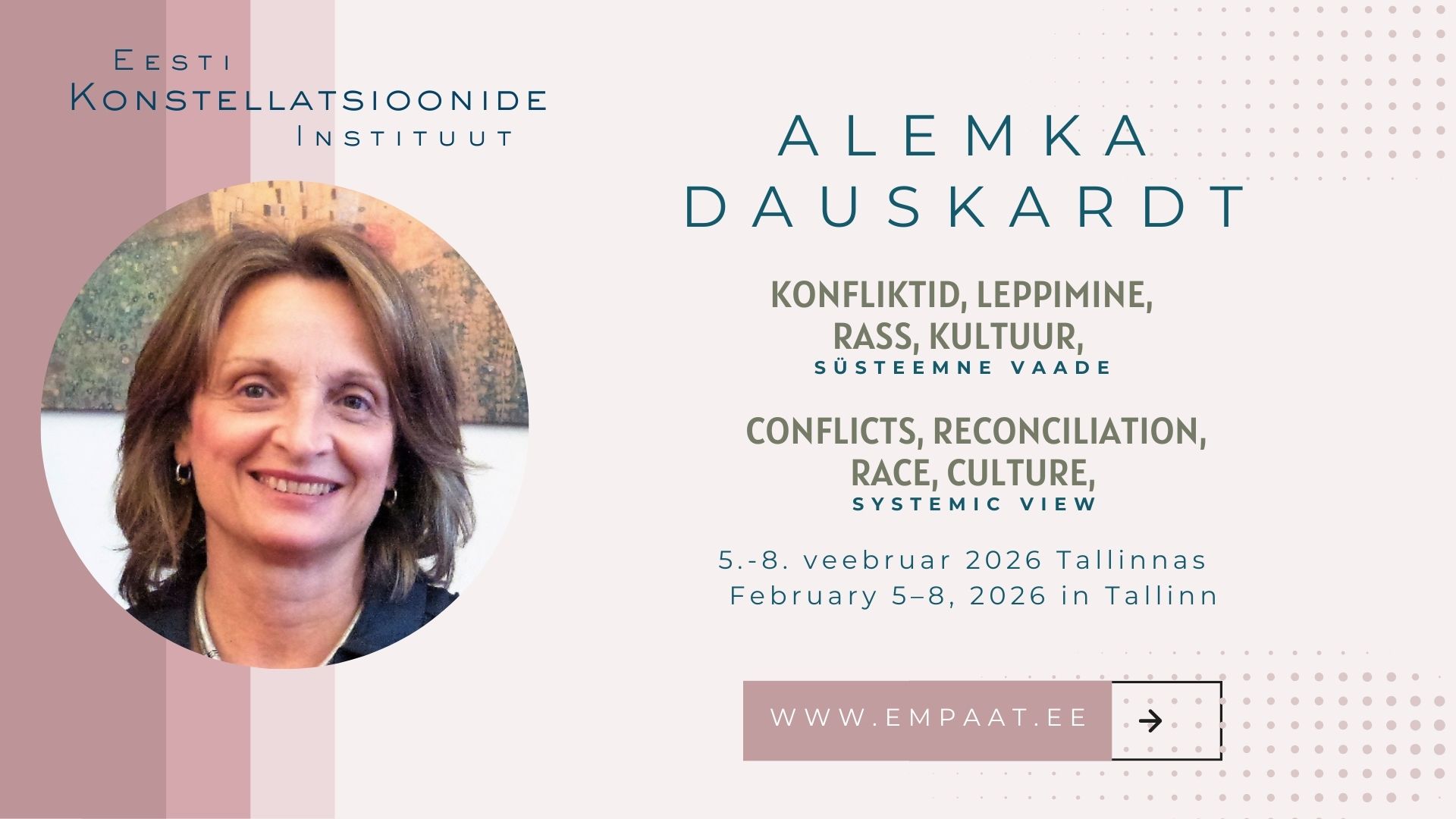
Conflicts, Reconciliation and Race, Culture
How can we begin to see and acknowledge the hidden patterns that keep us bound in repeating conflicts?
How can we find a path toward deeper reconciliation — within ourselves and in our societies?
This 4-day training, led by the internationally respected systemic and constellation facilitator Alemka Dauskardt, offers a unique framework for exploring these complex themes.
Through a phenomenological approach, we will explore the systemic laws and movements that operate beneath the surface of race, culture, and conflict.
You are invited on a journey of discovery — to explore the invisible forces that shape our understanding of conflict, and reconciliation, race and culture.
Through systemic work, we open the possibility to see what connects and separates us — and to move toward healing and wholeness.
What we will explore
CONFLICTS AS MESSENGERS OF THE SYSTEM
Conflicts are not merely clashes; they are messages from the system, pointing toward imbalance, unacknowledged pain, or unresolved past events.
Constellation work reveals the hidden layers within every conflict.
We will look into:
- The systemic nature of conflicts
- The influence of a third party, the convicted or the excluded, on the system
- Group conflicts and collective or national trauma (wars, genocides, deportations)
- Transgenerational transmission of trauma; how we deal with it in constellations according to Hellinger’s approach
- The effect of collective trauma on the individual – how does it function?
- Personal conflicts: when family or national history interferes with the personal
- Conflict driven by our need to belong
- Loyalty conflicts in intercultural and multicultural contexts
- The hidden dynamics of conflicts and wars. How past conflicts repeat in family and organizational systems
- The dynamics of victims, aggressors, and rescuers. The systemic dynamic on the individual and collective level – how we recognize it, how it manifests, and what we can do about it
- Conscience – personal, group, and spiritual
- Good and evil as relative categories
- The most horrific acts performed with a clear conscience
- What drives wars and which movements of the soul lead to peace.
- Collective constellations – when and how do we set them up.
CULTURE AS A SOURCE OF BELONGING AND IDENTITY
Culture is more than customs or traditions – it is a living system that gives us meaning, values, and a sense of belonging. Yet cultural differences can also create invisible boundaries, misunderstandings, and divisions.
Through systemic work, we explore:
- The multilayered nature of culture and its link to family, community history, and collective memory
- The unique systems of multicultural families
- How cultural heritage and ancestral experiences influence our present lives
- The systemic impact of migration and refugee experiences
- How the migrant or refugee identity affects individuals and their descendants
RACE AS A SYSTEMIC AND HISTORICAL PHENOMENON
Constellation work helps us see how racism and race-based trauma are passed down through generations – affecting both descendants of the oppressed and the oppressors – and how collective memory shapes our personal experience today.
We will explore:
- How we may be unconsciously connected to these themes, and how they manifest in us
- Hidden loyalties to ancestors who experienced racism, persecution, or colonial violence
RECONCILIATION AS A SYSTEMIC HEALING PROCESS
Reconciliation does not mean forgetting or excusing what happened.
It is a profound systemic process of acknowledging what is, honoring every participant and their fate, and giving each a rightful place in the system.
True reconciliation requires courage to face pain, shame, and loss.
We will explore:
- The power of acknowledgment — what it means to truly “see” another in their pain
- How blame and judgment affect reconciliation
- The meaning of collective reconciliation
- Reconciliation without the other: when the other is dead, absent, or unwilling
- Compensation and healing practices
Why join this training?
- Perhaps you feel affected by forces you cannot fully understand — carrying anxiety, anger, or sorrow that feels larger than your own story.
Perhaps certain patterns keep repeating in your relationships or work, despite your efforts to change them.
Constellation work allows us to see these forces and trace their origins. - You may be drawn to explore the deeper layers of reconciliation and conflict resolution — in personal relationships, communities, or society at large.
This work invites us to face hidden pain and restore balance within the system. - If you are part of a multicultural family or live far from your homeland, you may experience both richness and challenge: questions of loyalty, belonging, and identity.
This training offers a safe space to explore and integrate these experiences. - If you work with people affected by racial discrimination, cultural violence, or migration-related trauma — as a psychologist, social worker, teacher, or healthcare professional — this training will deepen your understanding and expand your tools for trauma-informed and culturally sensitive practice.
- If you carry historical or collective trauma in your lineage — war, deportation, genocide, forced migration — these are not merely events of the past. They live on in bodies, relationships, and family narratives.
Constellation work allows us to honor these stories and open the field for healing. - If you are a systemic practitioner wishing to grow in your understanding of race, culture, and collective trauma, this training offers a comprehensive and sensitive framework.
And if you are simply open to learning — no prior experience is needed. Only the willingness to look, feel, and learn.
This training is for you if you:
- Wish to integrate a deeper understanding of cultural and racial systems into your professional or personal practice
- Feel a personal or professional calling to explore race, culture, migration, or conflict through a healing and reconciling perspective
- Carry conscious or unconscious burdens related to your family, culture, or nation’s history and long for reconciliation
- Are ready to enter a phenomenological practice
- Work as a psychologist, psychotherapist, counselor, social worker, community facilitator, teacher, or educator
- Lead organizations or HR teams and wish to understand conflict dynamics more deeply
- Are involved in conflict resolution or mediation work
- Have already started your journey in therapy or constellation practice and want to deepen your understanding of race, culture, and conflict
- Or simply feel drawn to these themes in your own life.
About Alemka Dauskardt
Alemka Dauskardt is a psychologist whose education and work have spanned several continents and cultures.
She holds degrees in psychology from both Europe and Australia and has specialized in organizational psychology, relationship counseling, Gestalt therapy, and systemic constellation work.
Her approach weaves together diverse theoretical and practical traditions, always seeking “what truly helps” in each situation — for an individual, a group, or a system.
Her professional experience includes individual and group therapy, trauma and crisis integration, and extensive work with immigrants and refugees.
She facilitates constellations in family, organizational, and cultural systems.
Alemka’s first encounter with systemic constellations in 1995 was a turning point in her life. Since then, this work has shaped her personal and professional path.
She studied with Bert Hellinger, the founder of constellation work, and continued her learning with many leading practitioners in the field.
Together with her husband Max, she conducts trainings and workshops worldwide.
Her deep passion for systemic work is expressed through her presence, clarity, and dedication — both as a teacher and practitioner.
Alemka is the founder of Konstelacija, the Croatian Association for Systemic Constellations, which has created a space for learning, collaboration, and community for those called to this work.
At the heart of Alemka’s work lies a profound movement: honoring life and the systems that carry us, and the willingness to look toward the unseen — to bring into light what longs for acknowledgment and connection.
Details of participation
Dates: February 5 to 8, 2026
Time: Thu–Sat 10:00–18:00 ; Sun 10:00-16.00
Venue: Hestia Europa Hotel Conference Center, Paadi 5, Tallinn
Investment:
Registration until January 18: €520
From 19 January €560
For EKI alumni: €440
Language: English → Estonian
Coffee breaks are included in the price.
Contact: Kadri Riisik +372 52 76 247 kadri@empaat.ee
Register